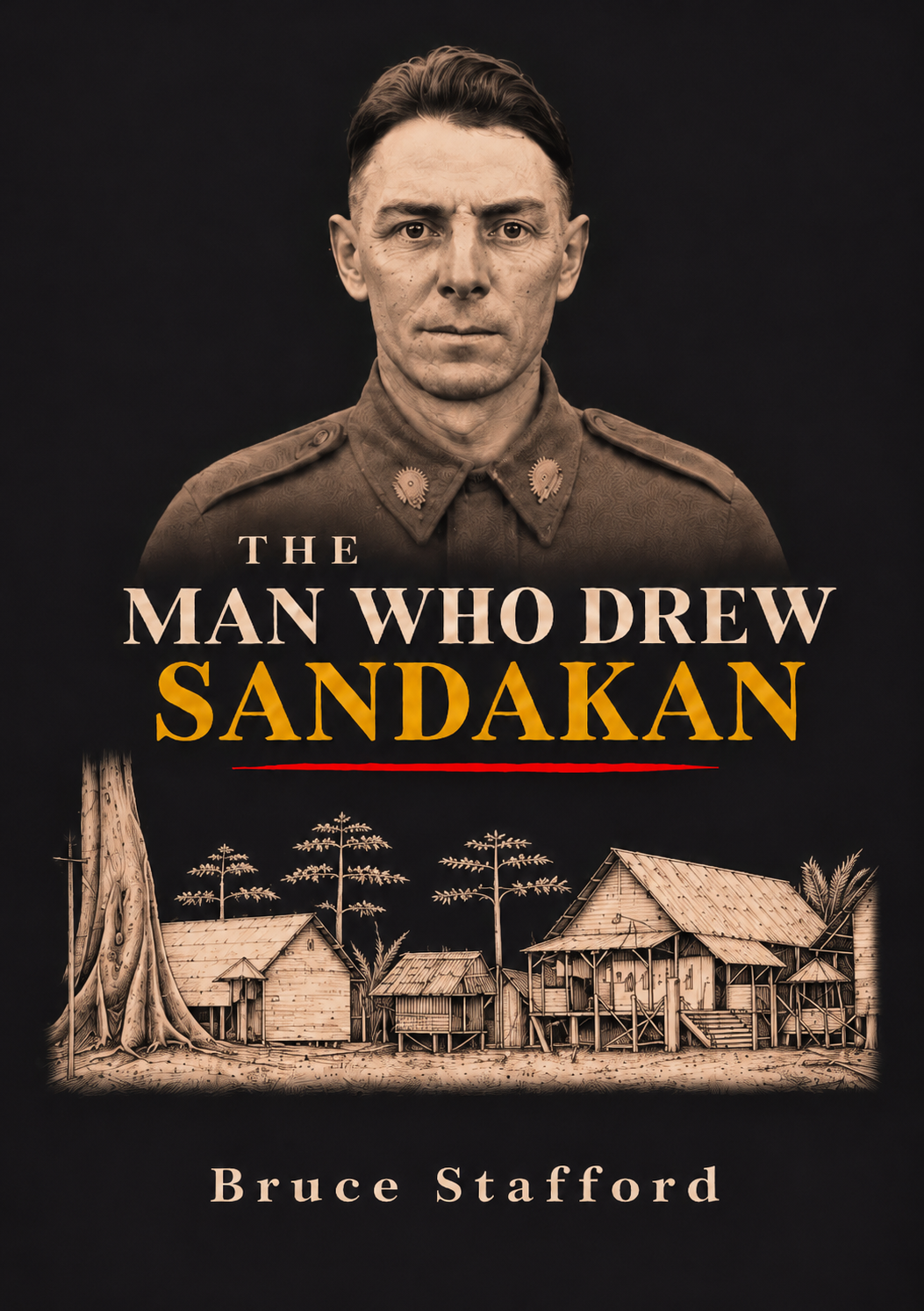
Biography · Coming in 2027
The Man Who Drew Sandakan
The life and artistic legacy of Corporal Frederick Edward Woodley
Corporal Frederick Edward Woodley was a shipwright, a husband, a father and a gifted artist. He was also one of the thousands of Australians who never returned from the Second World War.
Born in a small Hampshire village, Fred made a new life in Australia before enlisting in the Royal Australian Engineers. Sent to Malaya, he was captured following the fall of Singapore in February 1942 and eventually imprisoned at Sandakan in British North Borneo, one of the most notorious Japanese prisoner-of-war camps of the war.
There, amid starvation, forced labour and unimaginable suffering, Fred continued to draw. Two remarkable pencil drawings he created at Sandakan survived even though he did not.
Half a century later, those drawings would reveal an extraordinary connection to the family he had left behind.
Today, they are preserved at the Australian War Memorial in Canberra — an important part of our nation’s wartime history and a lasting visual record of a place where so many of the men who witnessed its horrors never lived to tell their stories.
The Man Who Drew Sandakan is a deeply personal biography of an ordinary Australian whose life stretched from rural England to Australia, Malaya, Singapore and finally Sandakan. It follows Fred not simply as a prisoner of war, but as a husband, father, tradesman, soldier and artist — and tells the story of the remarkable artistic legacy that endured long after his death.
A Sandakan story told through one man's life
Many books about Sandakan tell the broader history of the POW camp and the death marches. The Man Who Drew Sandakan approaches that history through one man.
Fred's story provides a human thread through the wider Sandakan tragedy: his childhood in Hampshire, migration to Australia, family life, military service, capture, imprisonment and the drawings he made while a prisoner of war.
Those drawings provide something unusually personal. They allow us to see part of Sandakan through Fred's own eyes and connect the historical record of an Australian POW camp with the life of the man who stood there and drew what he saw.